
 Search
Risk Management
SABIC's risk management processes identify potential threats and capitalize on opportunities to achieve strategic objectives.
Enterprise risk management
SABIC's Enterprise Risk Management (ERM) function implements a comprehensive and structured approach to managing risks and business continuity while identifying opportunities that support the company's strategy and long-term objectives. This approach includes identifying risks – both threats and related opportunities – in collaboration with stakeholders, and proactively mitigating risks or reducing potential impacts, supported by a robust Risk and Business Continuity Management Framework. ERM also provides early warning for emerging internal and external risks that could affect SABIC's objectives and the resilience of critical infrastructure.
Risk management governance
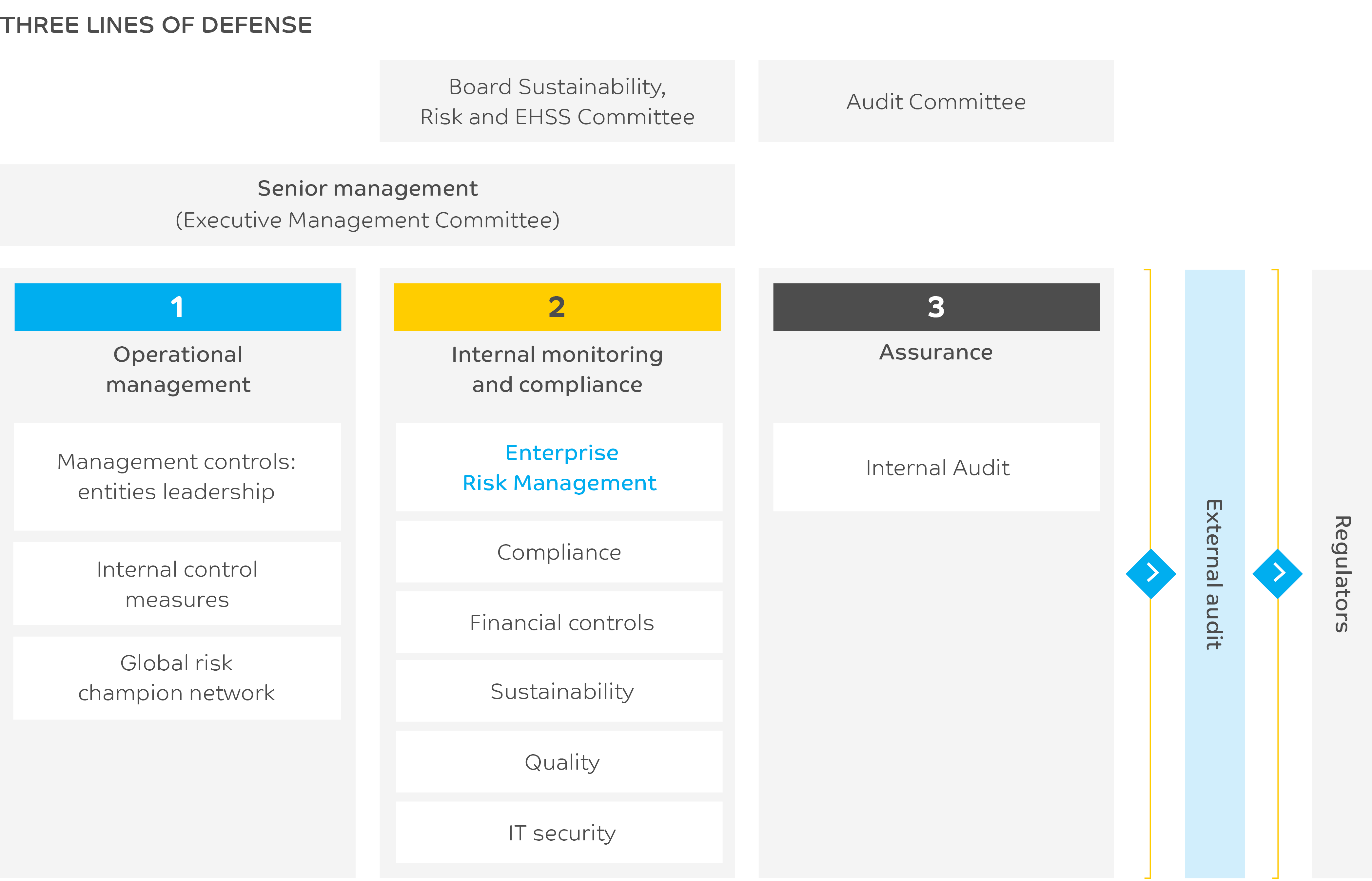
SABIC follows a “three lines” model to support effective risk management through clear accountability, defined roles and responsibilities, and robust processes. The Risk Management Policy and Framework are aligned with internationally recognized frameworks such as International Standards Organization (ISO) and the Committee of Sponsoring Organizations of the Treadway Commission (COSO).
Oversight of the Risk Management Policy, Framework and related procedures is exercised by the SABIC Board of Directors through its Board Sustainability, Risk and EHSS Committee (BSREC). Responsibility for implementing the policy and frameworks rests with the Chief Executive Officer (CEO).
The BSREC meets quarterly to review detailed ERM reports on top risks, evaluate the effectiveness of the risk management system, and provide recommendations to SABIC's Board on the adequacy of mitigation.
All business units and corporate functions submit quarterly risk reports through ERM to the Executive Management Committee, covering strategic, tactical, and operational risks. ERM activities are supported by SABIC's Global Risk Champion Network, comprising of senior business leaders who coordinate periodic risk assessments across the organization.
Risk management process
SABIC's risk management process, encapsulated within the broader Risk Management Framework, includes tools and mechanisms for managing and overseeing various risk categories faced by SABIC and its global affiliates.
SABIC's Risk Management Policy and Framework are reviewed periodically to reflect changes in international standards, regulatory mandates, the external environment, and stakeholder expectations. In 2025, the Risk Management policy was reviewed and re-ratified by the SABIC Board.
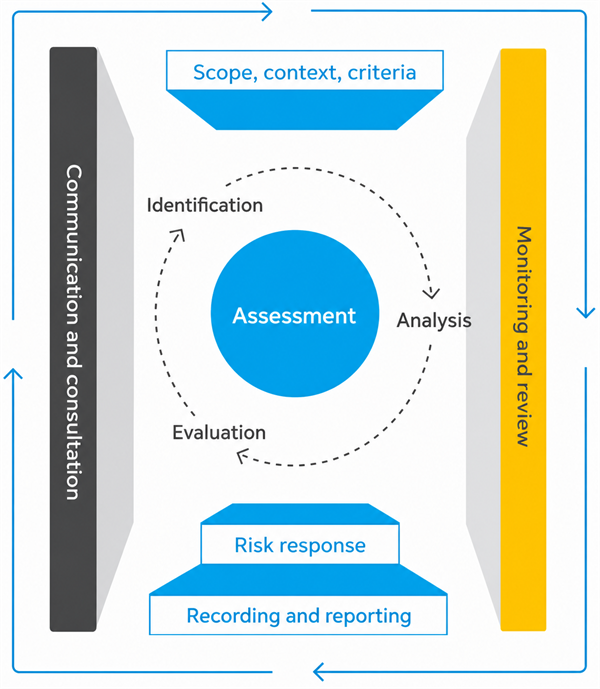
SABIC conducts periodic ground-up risk assessments across SBUs, corporate functions and sales offices, as well as during annual business planning, including risk quantification. These processes also support our projects and key initiatives, helping manage risks throughout their lifecycle.
2025 activities
SABIC enhanced its risk management and resilience programs through the following initiatives:
- Completion of the 2026 Business Planning Risk Assessment, enhancing insight into risks that may impact SABIC's short- and long-term objectives.
- Launch of the “Risk Radar” initiative to strengthen manufacturing site resilience and promote risk-informed decision making through training and interactive workshops across functions.
- Execution of an end-to-end risk and business continuity hybrid simulation exercise to further strengthen preparedness for geopolitical tensions.
- Expansion of the ERM Culture Capability Building and Business Continuity programs to elevate risk management and business continuity skills across the organization.
- Supporting all entities in their Business Continuity Management and Business Continuity Plans to boost resilience against major disruptions, such as IT outages.
- Conduct regular “Risk Champion” programs to foster knowledge sharing across SABIC.
- Collaborating with government and private sector entities to enhance ERM practices through expert advice and knowledge exchange.
- Enhanced risk management and business continuity activities within our investments and joint ventures to streamline risk discovery and resilience.
Our risk and resilience culture
SABIC entrusts employees to uphold the company's standards and maintain risk mindfulness. We aim to enhance employees' ability to identify and manage risks and have implemented several risk culture tools to reinforce this awareness. Additionally, our training programs, workshops, and knowledge-sharing events strengthen risk understanding and resilience across the organization.
2025 risk landscape
SABIC has response plans to minimize the impacts caused by major policy shifts, geopolitical tensions and conflicts, tariffs, and technological advancement affecting the global economy. These plans include updating inventory, considering alternative shipping routes, utilizing storage vessels, and reviewing tariff impacts and opportunities in relation to company objectives.
Digitalization is presenting challenges as well as opportunities for scaling business efficiencies. We conduct assessments to mitigate unfamiliar threats while leveraging the opportunities arising from digitalization and artificial intelligence.
The petrochemicals industry is subject to laws that govern emissions, waste administration, and resource utilization. At the same time, reporting requirements related to regulatory compliance are increasing. SABIC's response includes preparation for future compliance.
Implementation of double materiality assessment
SABIC recently moved into an additional paradigm for assessing and understanding risk through a double materiality lens, moving beyond traditional financial considerations to include how a company impacts society and the environment. This dual perspective recognizes that a company's activities can have effects on external factors, which can then influence the company itself, helping organizations understand their broader responsibilities.
Risk factors
SABIC may face risks inherent to the oil, gas, and petrochemical sectors. The impacts of these risks – both threats and opportunities – are managed through a range of strategic approaches. However, some factors remain beyond the company's control and could negatively affect its business, financial results, and operating conditions.
Strategic risks
- Highly competitive industries
- Cyclical nature of petrochemicals industry and market conditions
- Environmental challenges
- Evolving regulations relating to sustainability and ESG
- Digital transformation and artificial intelligence (AI)
Operational risks
- Talent management
- Disruption of supply chain services
- Geopolitical instability and pandemic
- Use of information technology
- Inherent process safety
- Projects under development
Compliance risks
- Intellectual property and technology licenses
- Disputes and/or litigation
- International trade controls
- Use and handling of materials and products
- Regional chemical regulations
Financial risks
- Customer credit
- Foreign exchange
- Insurance policies