 Search
SABIC Human Rights Program
Our Vision
At SABIC, we seek to create Chemistry that Matters™ in a manner that respects and fosters human rights in our daily operations. We embrace this same position with our business partners in our value chain, in the communities where we operate, and in the application and use of our products. We deploy numerous cross-functional resources in support of this aspiration.

Our Commitments
SABIC respects human rights in our own operations, in our value chain and in our communities, in accordance with the guidance set out by the following frameworks:
- UN Guiding Principles on Business and Human Rights
- International Labour Organization Declaration on Fundamental Principles and Rights at Work
- Principles of the UN Global Compact
- Saudi Vision 2030 guided by the principles of the Saudi Human Rights Commission
We act on this through our internal programs, due diligence and other capacity-building activities in our value chain, and our engagement with local communities.
We are signatories to the chemical industry’s Responsible Care® Global Charter. Responsible Care® supports human rights by aligning business practices with the principles of safety, health, environmental stewardship, and transparency.

Governance
Our human rights obligation starts at the top. Our Executive Committee is responsible for ensuring that our company operates in line with our Code of Ethics. Every corporate function and strategic business unit shares responsibility for upholding and advancing our human rights commitments across our value chain.
Access to Remedy
We proactively address potential human rights impacts of our business activities, mitigate negative impacts, and work to enhance the benefits to local communities. Our Speak-Up tools are available to all employees, contractors, suppliers and other third parties to report concerns. In case our employees or other stakeholders observe or experience actual or alleged violations of our Code of Ethics, Supplier Code of Conduct, other policies, or applicable law, we encourage them to report via our Speak-Up tools. We strictly prohibit retaliation against anyone for raising or helping to address a compliance concern.
Internal Processes
The Fair Employment Practices Policy in our Code of Ethics describes our culture of respect and fair employment practices that prohibit illegal discrimination.
Our EHSS Policy describes our commitment to operate facilities safely and responsibly, continuously improving programs to promote safety, and minimize employee and contractor injuries and illnesses.
Employees are trained on the content of both policies every two years.
SABIC complies with applicable laws and regulations and in cases where there is a conflict between applicable law and international human rights standards, we comply with applicable law and seek ways to honor the principles of international human rights standards. We expect our contractors to do the same.
CHILD LABOR
We require that the age of our employees be verified at the time of hire and we do not allow child labor in our operations and supply chain.
We do not hire individuals under the legal minimum age for employment or compulsory school age, whichever is higher.
Young workers (those above the legal working age but below 18 years of age) may be employed under SABIC-approved short-term internships, apprenticeships, or work experience programs, but not perform work that could jeopardize their health and safety or interfere with their education. Likewise, and as stated in our Supplier Code of Conduct, we expect our suppliers to adhere to relevant international standards and avoid child labor.
FORCED LABOR
SABIC does not use forced labor, including slave labor, military labor, debt bondage, involuntary prison labor, or human trafficking.
Employees are provided with a written employment document (e.g., offer letter, contract, etc.) that clearly states the terms and conditions of employment (e.g., hours of work, compensation, benefits, etc.) in a language that the employee understands and that is explained verbally as needed. Employment documents are agreed upon and signed in writing by employees and their employer.
As stated in our Supplier Code of Conduct, we expect our suppliers to adhere to the same standards and not use forced labor, including modern slavery and human trafficking, in our supply chain.
HARASSMENT AND DISCRIMINATION
We do not allow discrimination, retaliation, or harassment. We make employment-related decisions based on business needs, job requirements, individual performance, and qualifications. This includes equal opportunity in aspects of employment, such as hiring, benefits, compensation, promotion, and job assignments. We provide reasonable accommodation to qualified candidates and employees who have protected disabilities.
WAGES AND BENEFITS
SABIC strives to offer wages and benefits that support employees and their families. SABIC compensates its employees competitively within the market in which they are employed. Our employees receive wages that meet or exceed the legal minimum wage. Overtime is paid in accordance with local laws, and wages must be paid on time and in full.
For each pay period, employees receive a statement that shows the components of their compensation, including hours worked, benefits received, and deductions made in accordance with local laws. When it comes to our suppliers, we expect them to pursue a fair remuneration policy that complies, at a minimum, with local applicable working hours and wage laws, minimum wages, overtime wages, and mandated benefit requirements.
WORKING HOURS
We have guidelines for employee work, overtime and rest hours in our business operations, as we recognize the importance of work-life balance and the ability to operate safely. Outside of extraordinary circumstances we comply with international standards regarding work and rest hours.
SABIC also adheres to local laws and agreements with employee representative bodies which may provide for more stringent requirements. Furthermore, our shift managers and site EHSS personnel are trained in looking for signs of employee illness, fatigue, or inability to perform work safely, and to take appropriate measures to ensure the safety of our operations and employees. Similarly, we expect our suppliers to comply with applicable laws and collective agreements regarding maximum working hours.
HEALTH AND SAFETY
We have procedures in place to promote health and safety values throughout our company. These include our SABIC Safety, Security, Health and Environment management system (SHEMS), which sets standards to maintain an injury-free workplace as well as creating a positive health and well-being culture. Further information on SABIC's corporate website.
Our programs are certified to comply with key external standards:
- Responsible Care® 14001 certification at all chemical manufacturing locations around the world.
- ISO 14001 certification at all chemical manufacturing plants globally plus 90% of our other locations.
WATER AND SANITATION
SABIC is a signatory to the World Business Council for Sustainable Development (WBCSD) Pledge on Access to Safe Water, Sanitation, and Hygiene (WASH). We follow the WASH framework to guide our practices on safe water, sanitation, and hygiene at the workplace.
- Further information on SABIC's corporate website (Safety & Health).
- Further information on SABIC's corporate website (Environment).
LAND RIGHTS
When SABIC acquires land (including purchase, lease and use), we conduct fair and legal negotiations under the laws of the jurisdiction where the land is located. When it comes to our supply chain, particularly when sourcing raw materials such as minerals and biobased materials, we expect our suppliers to respect the rights of local communities and follow applicable laws.

External Processes
SABIC has a strong culture of giving and volunteerism that complements our commitment to human rights. This culture inspires our investments in corporate social responsibility (CSR) programs to create lasting, positive impacts throughout our global communities.
In our supply chain, we use our Supplier Lifecycle Management Due Diligence program to minimize human rights risks. All direct suppliers must acknowledge our Supplier Code of Conduct, which includes specific labor and human rights expectations. They also undergo pre-contract screening, which includes questions around employee wages, age and working conditions. Higher risk suppliers are provided with training via an independent specialist (Trace International). Local language training courses include topics such as avoiding trafficked labor, anti-bribery and economic sanctions compliance.
Temporary and contract workers must acknowledge our Temporary Worker Code of Conduct. Temporary workers, along with SABIC distributors, are assigned a suite of compliance training courses.

Freedom of expression
Freedom of expression, association, and peaceful assembly support stable business. SABIC provides numerous channels for employees to raise concerns or grievances to management, including through workers committees in applicable jurisdictions. We respect workers’ right to join an organization of their choosing and expect the same of our suppliers. We prohibit intimidation, harassment, retaliation or violence against employees who seek to exercise these rights. We engage in constructive dialog with works councils and labor committees and similar employee representative bodies.
Responsible Recruitment
SABIC takes responsibility to uphold fair and responsible recruitment principles and practices that respect internationally recognized human rights. We contractually require providers of contract or temporary labor to follow a responsible recruitment procedure, including:
- Zero tolerance for forced, involuntary, or exploitative recruitment and employment, including use of prison labor, indentured labor, bonded (including debt bonded) labor, human trafficking, child labor or slave labor.
- As part of the hiring process, workers shall be provided with a written employment agreement in their native language, describing the terms and conditions of employment.
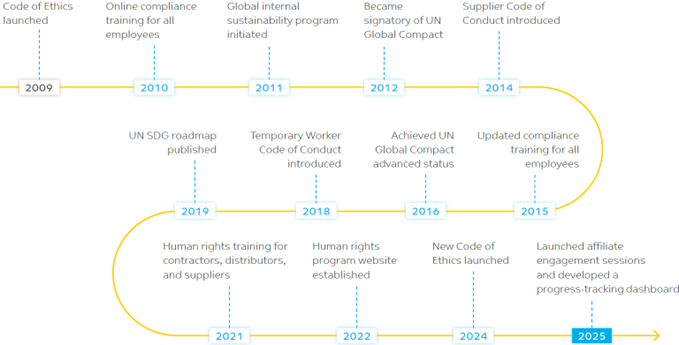
SABIC Human Rights Timeline